
Cloud, Mobile, and IoT Security | Ethical Hacker Course Kenya
Master advanced attack vectors in cloud computing, mobile ecosystems, and IoT devices. Part of the comprehensive Certified Ethical Hacker (CEH) training at SamaTech Institute Kenya.
Researching Attack Vectors on Cloud Technologies
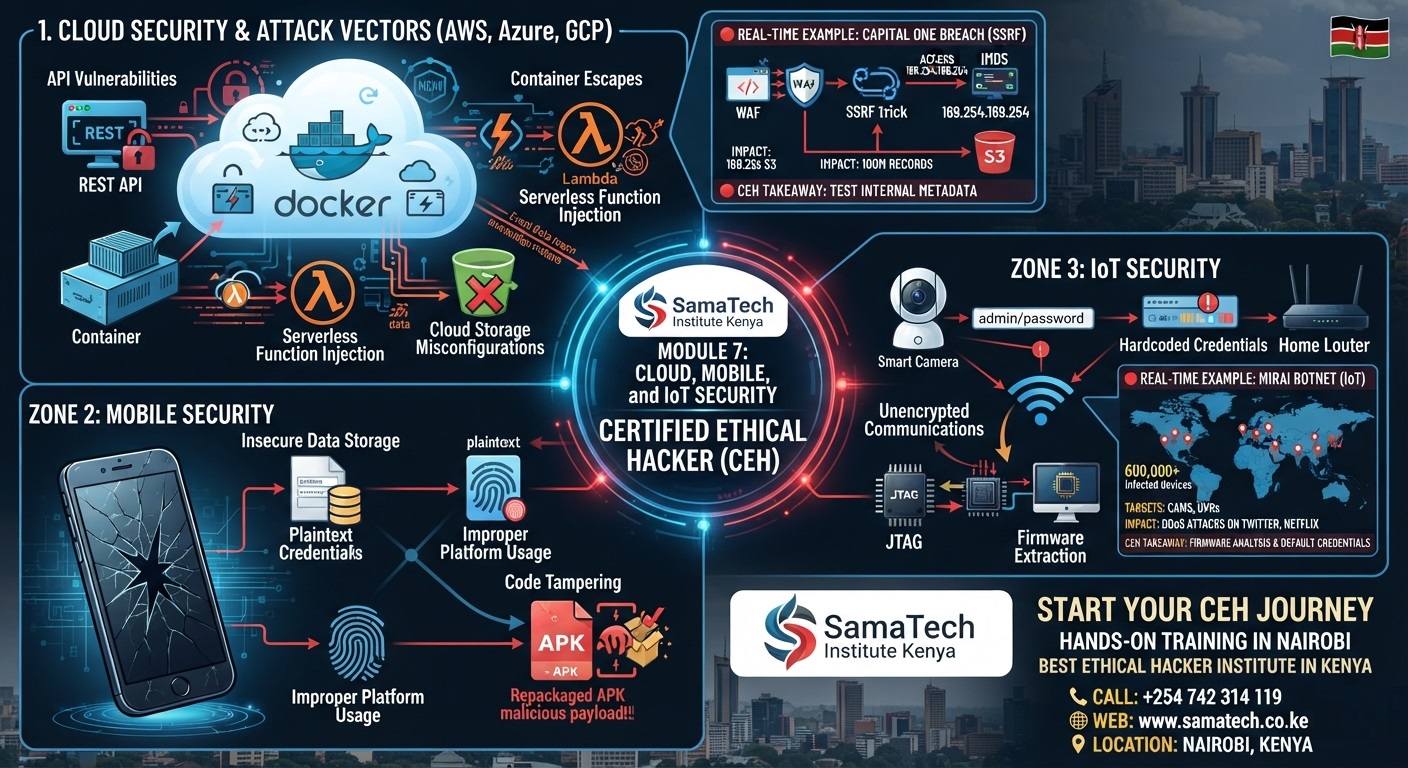
In modern enterprise environments, cloud infrastructure (AWS, Azure, GCP) has replaced traditional data centers. As an ethical hacker, you must understand how misconfigurations lead to catastrophic breaches. This module covers:
- API Vulnerabilities: Exploiting insecure REST/SOAP APIs that lack proper authentication.
- Container Escapes: Breaking out of Docker/Kubernetes pods to access the host kernel.
- Serverless Function Injection: Manipulating Lambda/Azure Functions through event data poisoning.
- Cloud Storage Misconfigurations: Identifying public S3 buckets and unsecured Blob storage.
🔴 Real-Time Example: The Capital One Breach (SSRF)
The Attack: An attacker exploited a Server-Side Request Forgery (SSRF) vulnerability in a web application firewall (WAF) hosted on AWS. By crafting a specific request, the attacker tricked the server into querying the AWS Instance Metadata Service (IMDS).
The Impact: The metadata service returned temporary IAM credentials, allowing the attacker to access 100 million customer records stored in S3 buckets.
CEH Takeaway: Always test for SSRF against internal cloud metadata endpoints (169.254.169.254) during penetration tests.
Common Attacks Against Specialized Systems (IoT & Mobile)
Specialized systems often lack the security rigor of traditional IT. In our ethical hacking course in Kenya, we teach you to audit these fragile ecosystems:
Mobile Security
- Insecure Data Storage: Plaintext credentials in SharedPreferences/NSUserDefaults.
- Improper Platform Usage: Bypassing biometric auth or clipboard leakage.
- Code Tampering: Repackaging APKs/IPAs with malicious payloads.
🌐 IoT Security
- Hardcoded Credentials: Default admin/password combos in firmware.
- Unencrypted Communications: MQTT/CoAP traffic sent over HTTP.
- Firmware Extraction: Dumping flash memory via UART/JTAG interfaces.
🔴 Real-Time Example: Mirai Botnet (IoT)
The Attack: The Mirai malware scanned the internet for IoT devices (cameras, DVRs) using a hardcoded list of 60+ default username/password combinations.
The Impact: Infected 600,000+ devices to launch massive DDoS attacks, taking down major services like Twitter, Netflix, and Reddit in 2016.
CEH Takeaway: IoT pentesting MUST include firmware analysis and default credential testing. Never assume “security by obscurity” works.
Start Your CEH Journey at SamaTech Institute Kenya
Don’t just learn theory—practice these attacks in our state-of-the-art labs. SamaTech is recognized as the best ethical hacker institute in Kenya, offering hands-on training in Nairobi with job placement support.
📞 Contact: +254 742 314 119
Website: www.samatech.co.ke
📍 Location: Nairobi, Kenya (Online & In-Person Options)